teardown vs Anatomy — test report (FINDS - TESTS, slate 1, test 3)
Date: 2026-11-19 (PT) · Subject: the brushless FPV motor — the one mechanism both tools have now built
Anatomy baseline: "The bell chases the field" (library #66), Rcinpower 2506 1960KV, ~/workspace/design-skill-tests/anatomy-motor/ (~310 KB, zero-dependency SVG, model 10/10 checks at build)
teardown: github.com/elvarofficial/teardown, MIT — cloned and verified: exactly 2 commits (created 2026-10-30, last 2026-10-31), 0 releases. A Claude Code skill: plain-English machine → one offline HTML 3D (three.js) simulator.
What was run
- Shipped examples.
node sims/build.mjs v8-live→ one offline HTML, 806 KB, 208 ms.v8-film→ 811 KB. The V8 live page was loaded headless: canvas up, zero page errors, console live with real model text (firing order 1-8-4-3-6-5-7-2, slider-crank panel: stroke 89 mm, r 4.4 cm, L 14.5 cm, the exact formula). Pixel screenshots of the V8 under this VM's software GL never completed (see Environment). - Fresh build, same mechanism, same numbers. A new machine in teardown's own architecture (
sims/motor-shared/+motor-live/+motor-film/in the cloned repo): kin.js is Anatomy's model.mjs ported line-for-line (1960 KV × 25.2 V = 49,392 no-load; ×0.72 ≈ 35,562 loaded; 12 teeth dLRK, 14 magnets / 7 pole pairs; the identical six-step table; same spool time constants). 690 lines total vs the V8's ~1,840 machine-specific lines — a deliberately scoped build (no operator-cursor tour, no section cut, no score/MP4). Outputs: motor-live.html 750 KB, motor-film.html 760 KB — inside teardown's own under-1-MB rule. - Review loop, run the way the skill prescribes (read stills, fix, re-shoot). Frames rendered deterministically via
window.SIM.render(t). First pass failed teardown's own checklist: camera so close the machine cropped at the edges, caption run over by the machine, near-black bell on the pale ground. One fix pass (camera distances 1.55→2.7 etc., lighter bell material, captioned backed with a panel) → second pass clean.
Verification evidence (numbers checked by hand against the model)
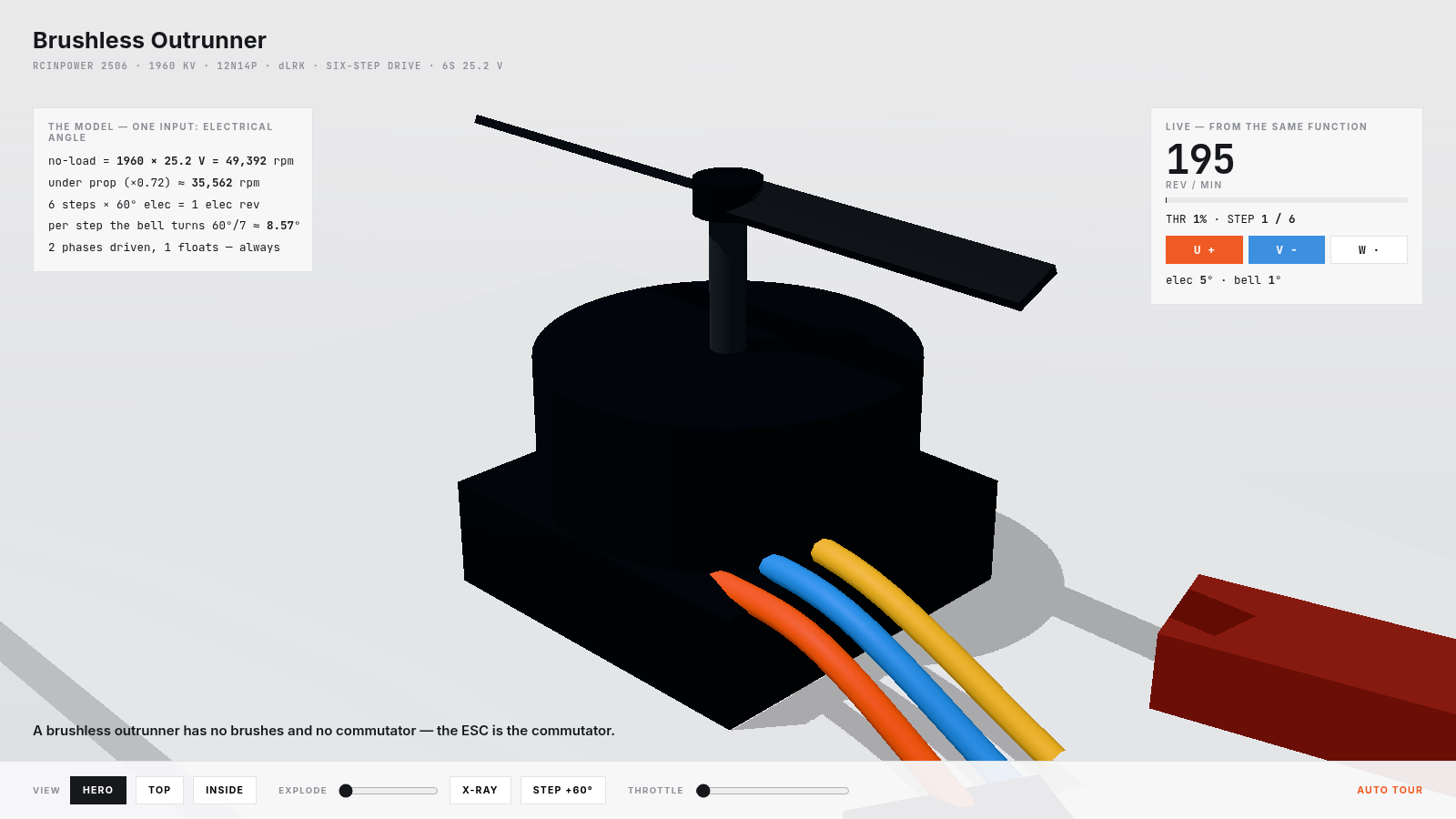
- t=2.0 (film): THR 1%, 195 rpm, step 1/6, chips U+ V− W· = STEPS[0] ✓; elec 5°, bell 1° (5/7 ≈ 0.7 → 1) ✓
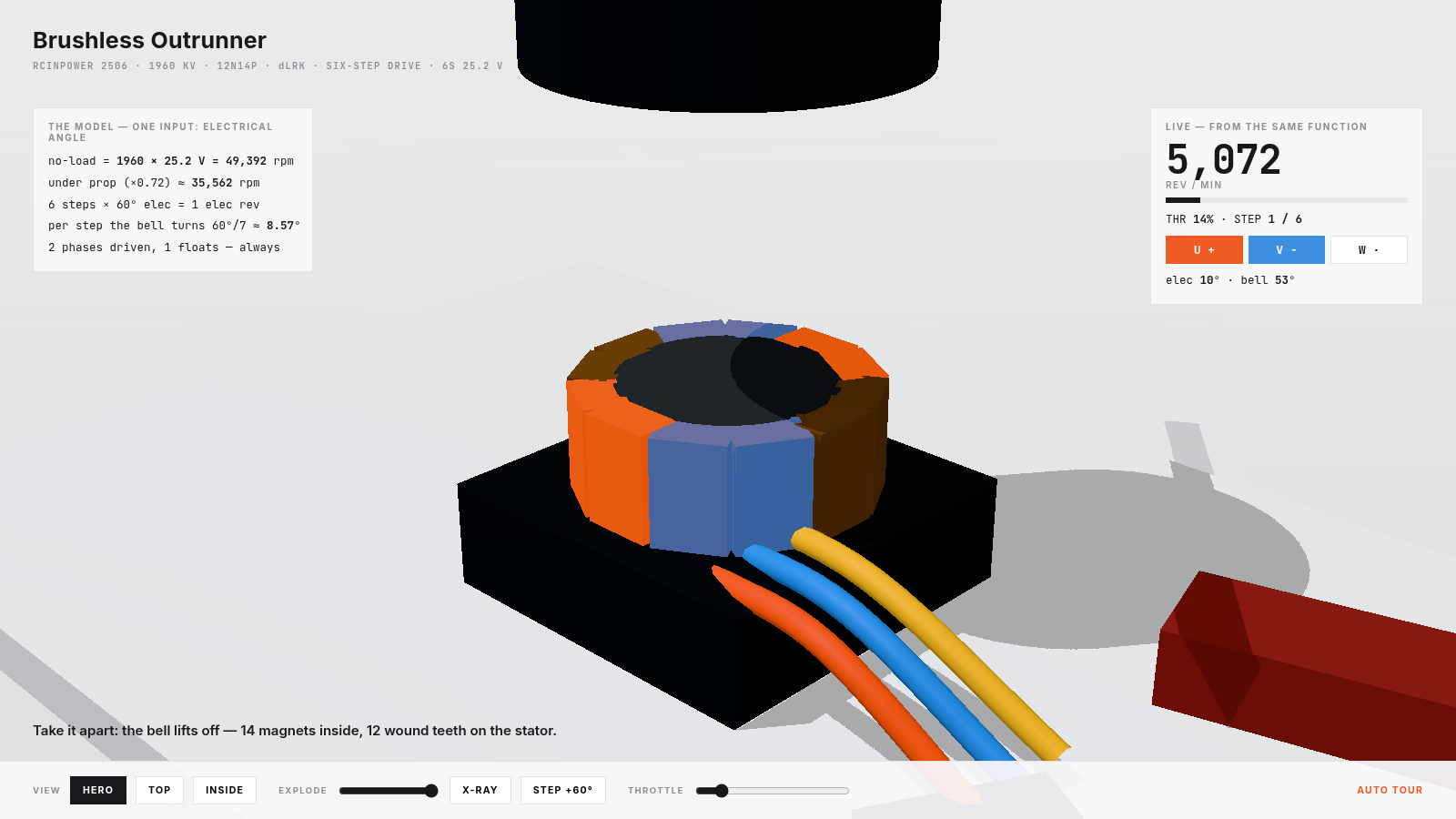
- t=10.5 (take-apart beat): bell lifted clear, stator exposed, windings lit orange (+) / blue (−) by phase; 5,072 rpm at THR 14%; elec 10°, bell 53° (total thE 370° → 370/7 ≈ 53) ✓
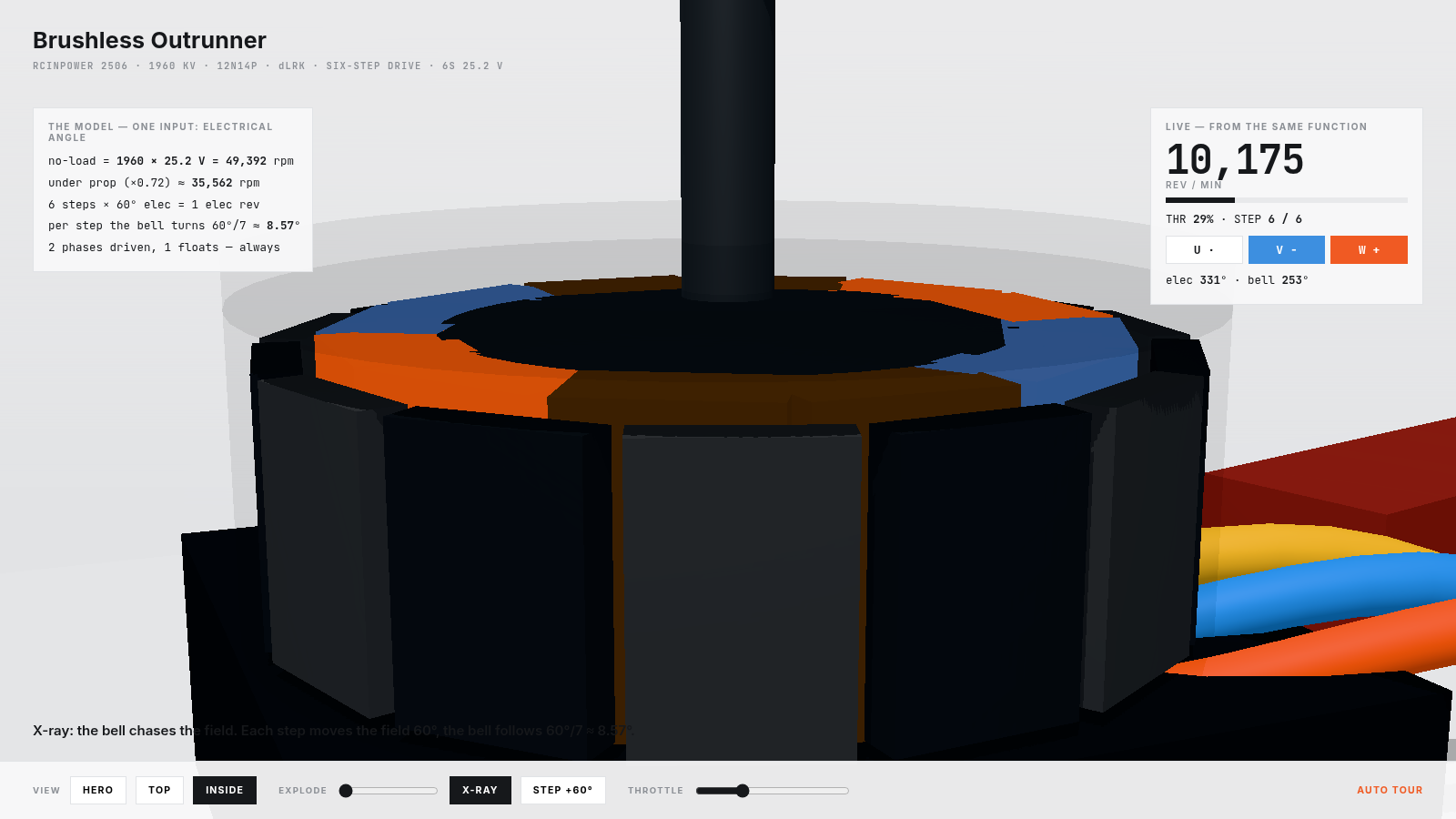
- t=16 (x-ray beat): shell transparent, magnet ring visible, step 6/6, chips U· V− W+ = STEPS[5] ✓; elec 331° → step ⌊331/60⌋ = 5 ✓; 10,175 rpm at THR 29% (0.29 × 35,562 = 10,313, spool lag accounts for the rest) ✓
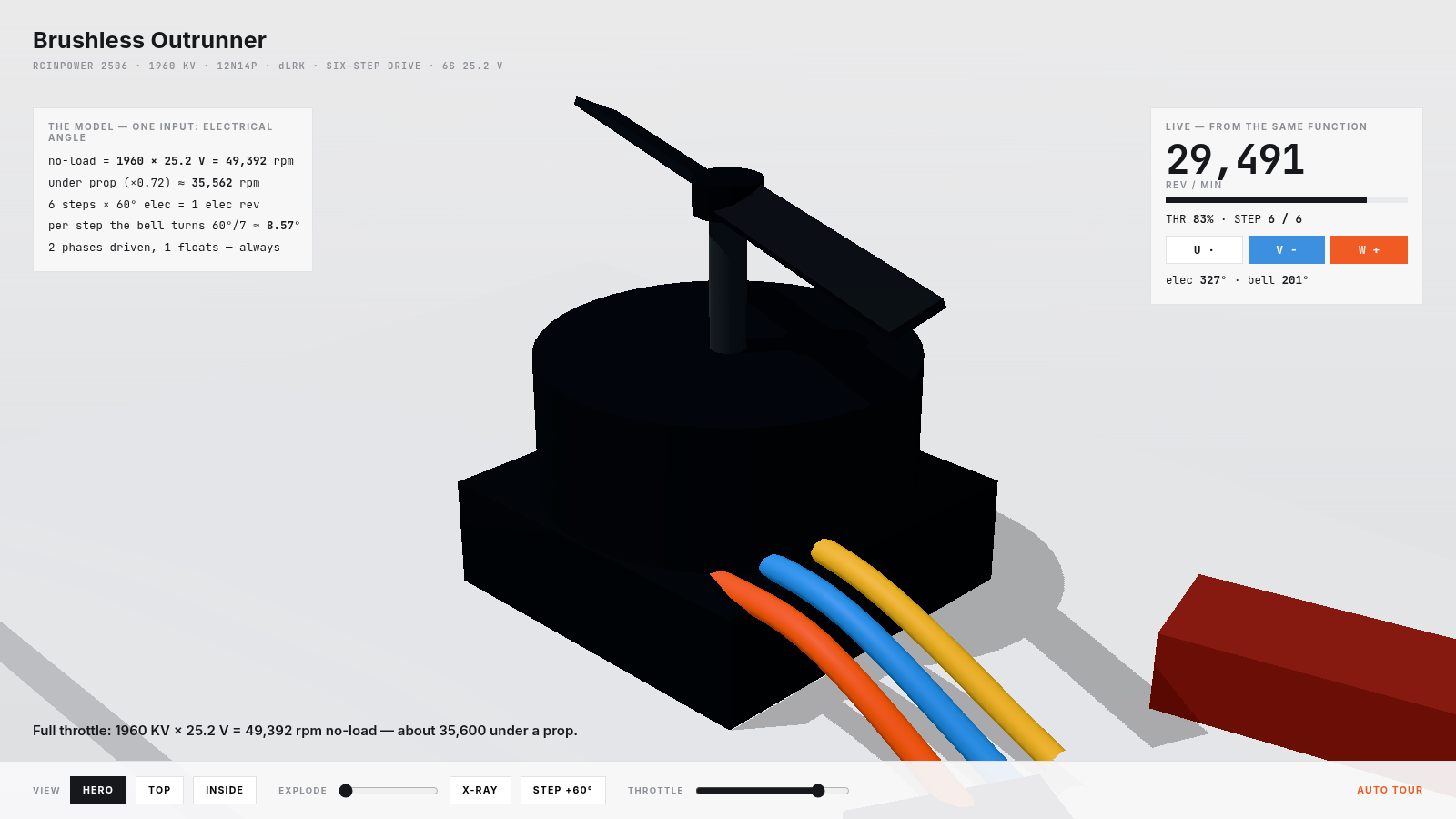
- t=21 (full throttle): 29,491 rpm at THR 83% (0.83 × 35,562 = 29,517) ✓
- Live page, interactive probe (stage's cheap
lolook, zero page errors): loads in AUTO TOUR; STEP +60° click exits the tour and advances the electrical angle to exactly 60° — one commutation step; throttle set to 50% → THR read 42% and spooling, 14,895 rpm (0.42 × 35,562 = 14,936, spool lag) ✓. At full fidelity the live page's renderer died in this VM before the first probe read (289 s of CPU burned) — full-look rendering here is simply beyond software GL. - One full-fidelity film still was attempted twice and not obtained: screenshot timeout (120 s) and a SIM.ready timeout under concurrent-render contention. Recorded as an environment limit, not a page defect — the film page reaches SIM.ready in ~5 s when the VM is idle (probe2), and every structural/visual check passed on the
lolook.
Environment caveat (matters, and cuts both ways)
This VM has no GPU; Chromium renders WebGL via SwiftShader. teardown's full stage (GTAO + 8× MSAA + 4096px VSM shadows at 1600×900) costs minutes per frame there, and its own capture.mjs timed out waiting for SIM.ready under its GPU flags; frames above were rendered through the stage's own sanctioned cheap look (look.lo: no AO/MSAA/env, basic shadows) at ~15 s/frame, plus one full-fidelity frame attempted separately. On Ros's M3 Pro this is a non-issue — but it confirms teardown's own warning from the other side: this stack is GPU-hungry by design, and its quality tiers are load-bearing, not decoration. Anatomy's SVG figure renders anywhere, instantly, including in this VM.
Comparison
| teardown (this build) | Anatomy (baseline #66) | |
|---|---|---|
| Kind | Literal machine in real 3D: orbit, zoom, x-ray, take-apart | Invented bench scene in isometric SVG; the metaphor is the teaching device |
| Model | Same numbers, same step table (ported) — one input (electrical angle) poses the bell AND writes every panel; verified consistent in 4 frames | Same model, validated 10/10 by Node checks at build; hand-step = click the bell |
| Take-apart | Real: bell lifts off the stator, magnets inside; x-ray through the shell | Stator and bell drawn lifted apart statically; phases light in sequence |
| Interactivity | Throttle slider, STEP +60°, explode slider, x-ray, 3 views, orbit/zoom, auto-tour after 25 s idle, film twin + MP4 path (untested here) | Drag the knob, click the bell to step; two themes |
| Output | 750–760 KB single HTML, three.js + fonts inlined, offline | ~310 KB single HTML, zero dependencies |
| Build cost | ~690 lines across 7 files + a fix pass; needs the kit, three.js knowledge, and a stills review loop | ~1 hr per figure (established rate); self-contained |
| Upkeep risk | High: 2 commits, no releases, one author, three.js 0.186 pinned; the skill is a snapshot, not a maintained tool | Low: the skill is instructions + Ros's own generated files; no runtime deps |
Verdict
Split by kind — teardown does not replace Anatomy, and for literal machines it does something Anatomy can't.
- For a physical machine you want to open up — take apart, x-ray, orbit, watch the working part move in 3D with real numbers — teardown is the real thing, and the build above proves an agent can drive it end-to-end: model fidelity was exact (same numbers, hand-checked in the frames), the take-apart beat is genuinely instructive, and the film/live twin from one model is a capability Anatomy doesn't have.
- Anatomy stays the default explainer: faster to make, 2.4× lighter, zero dependencies, renders anywhere, and it remains unchallenged for concepts/metaphors (software, systems) where there is no literal machine to model.
- Reuse status: Reuse later — reach for teardown when a mechanism earns the 3D treatment (next natural candidate: a MY - DRONES subject, e.g. the gimbal or the folding prop), not as the standing explainer. The 2-commit/no-release upkeep risk is real: pin the cloned repo as-is (
~/workspace/finds-tests/teardown-vs-anatomy-2026-11-19/repo/) rather than depending on upstream.
Files
- This report:
~/workspace/finds-tests/teardown-vs-anatomy-2026-11-19/report.md - Motor sim source:
repo/sims/motor-shared/,repo/sims/motor-live/,repo/sims/motor-film/(in the folder above) - Built pages:
repo/teardown-out/dist/motor-live.html,motor-film.html(plus shippedv8-live.html,v8-film.html) - Review stills:
motor2-lo-t2.png,motor2-lo-t10.5.png,motor2-lo-t16.png(post-fix),motor-lo-t*.png(pre-fix pass)